


vanaf € 1.249,95


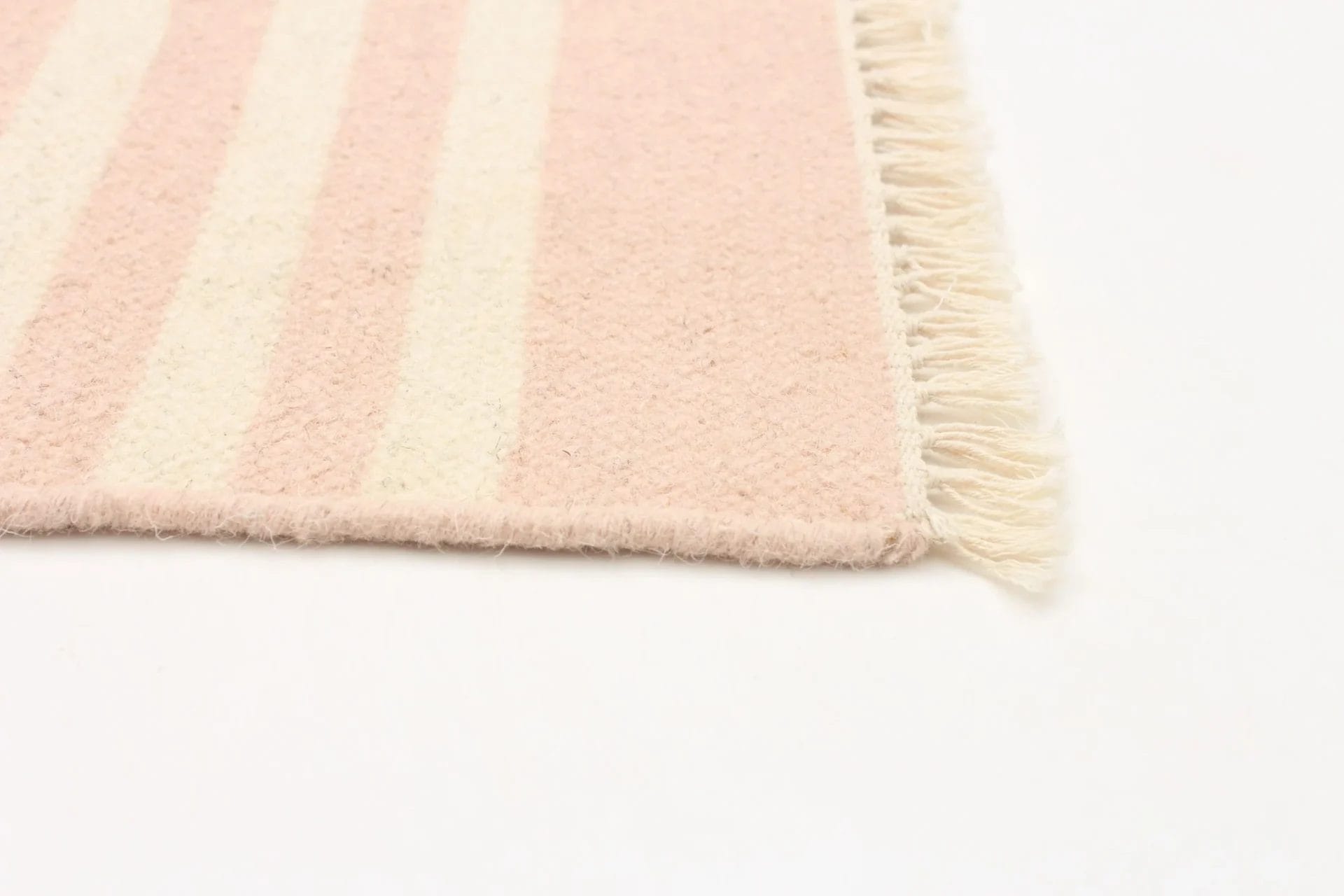


Camille Kelim rug pink
€ 900,00
1 in stock
Free delivery. Vóór 17:00 besteld, bezorgd tussen di 22 en vr 25 sep.
30-day returns policy. No hassle, from any country.
A unique item. Hand-knotted, with subtle variations in every rug.

“Every piece is the work of skilled craftspeople – handcrafted according to traditions that have been passed down through the generations.”
Product information
All about this product
Description
Turkish kilims are lightweight yet sturdy plain weave rugs that are perfect for high-traffic areas such as the hallway or kitchen. Contemporary/modern, plain weave & kilims, stripes, transitional style kilim with ivory and salmon accent colors. Imported from Turkey and manufactured using the finest weaving techniques. Plain woven and made of 100% wool with a backing of 100% cotton. 154.9 cm x 233.7 cm.
Zuivere scheerwol is van nature vuilafstotend en veerkrachtig, en wordt gewassen en gekaard in plaats van chemisch verzacht, wat de vezel elastisch houdt en het tapijt jarenlang laat meegaan.
Maintenance
With proper care, your pink Camille Kelim rug will last for years. Keep it simple:
- Vacuuming once a week with a smooth nozzle and no rotating brush.
- Blot stains immediately using a clean, slightly damp cloth, and never rub.
- A few times a year to ensure even wear.
- Avoid: harsh cleaning products and prolonged exposure to strong sunlight.
Material recommendations
- Wool: naturally stain-resistant and hard-wearing; regular vacuuming is usually sufficient, and stains can be easily dabbed away.
This is how you keep the colors and fibers of your pink Camille Kelim rug in optimal condition for years.
Delivery & returns
Delivery. We will process your order within 1–2 working days. Your rug will then be delivered to you within 4–8 days. You will receive a tracking number.
Free delivery within Europe, no minimum order. We deliver outside Europe on request.
Hassle-free returns. Not entirely satisfied? You have 30 days to return your rug, from any country. We’ll help you quickly and personally.
Specifications
Craftsmanship in every detail.
| Colour | Pink |
| Origin | Turkey |
| Form | Rectangle |
| Accent Colors | Ivory, Pink |
| Age | New |
| Tissue | Flat woven |
| Material | Wool |
| Cartridge | Stripes |
| Collection | Ankara |
| Density (KPSI) | Flat tissue |
| Fringes | With fringes |
| Thickness | Flat |
| Length | 234 cm |
| Width | 155 cm |
| Style | Plains & Stripes, Kilim, Modern |
| Rug Type | Turkish Wool Kilim |
| Advantages | Breathability, Allergen-free, Handmade, Pet-friendly, Hypoallergenic |
| Pole height | Low pile |
| Size | 234 x 155 cm |
| Rug size | Medium-sized |

heer Reinders
Verified review
Snelle levering en goed advies voor retourzending van te veel geleverde artikelen.
Marcus Janssen
Verified review
Prachtig en byzonder vloerkleed gevonden. Sympathieke klantenservice. Duurde even voordat het in huis was, moest van land van herkomst komen. Was het wachten meer dan waard. Aanrader!!
Linda De Reus
Verified review
They’re very helpful when you ask questions by email and really think things through with you!
Anastasia
Verified review
Delivered quickly, good fabric.
Frequently Asked Questions
Good to know
The word ‘kelim’ derives via Turkish from the Persian word ‘gelim’, which refers to a flat-woven rug. In English and German, it is spelled ‘kilim’. A Moroccan flat-woven kelim is known locally as ‘hanbel’.
Turn the rug over: the front and back show the same pattern in mirror image. Hold it up to the light and look for small gaps along the vertical colour boundaries. The sides are slightly wavy and the fringes are the ends of the warp threads, which have not been sewn on.
These are the marks left by the slit-weave technique. Where two colours meet vertically, the weft thread reverses direction and a slit remains open. These slits are a characteristic of handweaving and are not a weaving fault.
Veel Anatolische motieven hebben een vaste betekenis: elibelinde (handen in de zij) staat voor moederschap en vruchtbaarheid, de ramshoorn voor kracht, het oog en de haak voor bescherming tegen het boze oog, en de waterloop voor water als bron van leven. Deze geometrische vormentaal zie je terug in de patronen van de kelim vloerkleden in de collectie op deze pagina, onder andere in de rode en paarse exemplaren.
Traditionally, plant-based dyes were used: madder for red, indigo for blue, woad or onion skins for yellow, and walnut husks for brown. Since the end of the nineteenth century, synthetic dyes have also been used, which are brighter and more uniform in colour.
A kilim is flat-woven without a pile; a Berber rug is hand-knotted with a thick, soft pile. A kilim is thinner, lighter and can be used on both sides, and originates from Anatolia, Persia or the Atlas Mountains. A Berber rug originates from the Moroccan Atlas Mountains and provides better insulation and sound absorption.
Stofzuig beide zijden regelmatig op lage stand, zonder roterende borstel. Dep vlekken direct met een vochtige doek en een druppel pH-neutraal wolwasmiddel. Kleine kelims kun je met de hand in lauw water wassen en plat laten drogen; grotere kleden laat je professioneel reinigen. Vermijd een plek in direct zonlicht: plantaardige verfstoffen vervagen onder lichtinvloed, zoals bij vintage kleden zichtbaar is.
Yes. A kilim is thin and has no pile, which means it retains less heat than a knotted rug. Most of the heat from the floor is retained.
Yes, this is one of the most common places to put a kilim. Thanks to its flat weave, chairs glide smoothly across it and crumbs stay on the surface. Choose a size that ensures the chairs remain on the rug even when pushed back.
A kilim is lightweight and is dispatched rolled up. Upon receipt, roll the rug briefly against the grain and lay it flat, placing something heavy on the corners. Placing a non-slip mat under the entire rug will then keep the edges flat.
A vintage kilim is a rug that has been used before, usually for twenty years or more. The vegetable dyes have faded slightly due to wear and exposure to light. Minor repairs, worn fringes or uneven edges are all part of its character.
Use a thin non-slip mat made of rubber or felt with a rubber backing that is slightly smaller than the rug. A thick felt mat makes the rug unnecessarily bulky; a thin mat keeps the kilim flat and prevents it from sliding on smooth floors.
Complete the look
More Kelim rugs

Oorspronkelijke prijs was: € 4.325,95.€ 3.028,95Huidige prijs is: € 3.028,95.


vanaf € 1.121,95


vanaf € 2.849,95

Camille Kelim rug pink
